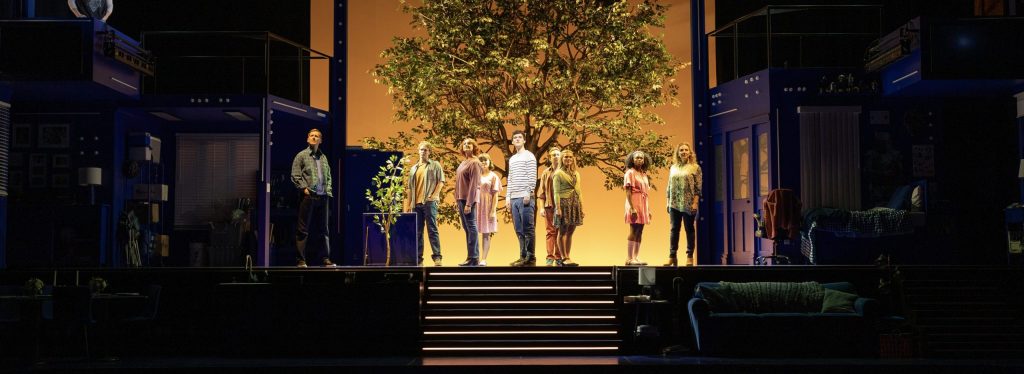
Find and Sign is a romantic comedy set against the backdrop of the hip-hop music industry in New York City. That canvas for the story allows many different issues – about race, and class, and education – to arise. I spoke recently with PTC Resident Sound Designer Matthew Tibbs about his process in composing and designing the very specific sound for this show.
1. You created the original music for Find and Sign – which is very contemporary, and very specific to the story – with University of Utah student Adam Harris. What has that collaboration been like?
Working with Adam – a current sophomore in the sound design program – has been great. We spent the first week showing him around Logic (the software we’re primarily using) and both of us learning about “beat making.” He’s a drummer, so he took to the project structure very quickly. Working with students in a different context, for instance on a PTC show with established professionals as opposed to a U Theatre show in an educational environment, is really valuable experience and training for the student. There’s a lot of money riding on executing a professional stage production well, so there’s an expectation and assumption that people will be “on point.”
2. Original hip-hop artists B-Side, a local artist, and Bronx rapper Majesty have songs that appear in Find and Sign. Was there a certain aesthetic to these artists’ sounds that attracted you to their music for this show?
I wanted to use artists that aren’t yet heard on the radio, and these two musicians obviously have the chops to make a career out of music. I wanted to help maintain the suspension of disbelief, and part of that was finding original music that served the show. The entire project had a very do-it-yourself approach for me, so it was just a matter of finding the right fit. One thing I found interesting was that both artists’ songs came off albums that are deeply personal. Themes of family, love, redemption, alienation, and struggle are universal and aren’t relegated to a particular culture or genre.
3. How has this show differed from other shows you’ve composed in the past?
This show had a very specific sound and genre attached to it. Composition can often just be broken into a particular time period or specific instrumentation, but I had several criteria for what the music should be. It needed to be very current, with an East Coast/NYC vibe. Hip-hop, even with the cross-pollination of the Internet, is still fairly region-specific. We tossed a couple tracks that had what I would describe as a West Coast sound. Even in the instrumentals, you can often tell whether a beat was created in the South, Houston, California, etc.
I consume a lot of music, and, yeah, I have listened to hip-hop off and on since high school. I got deeper into the genre, and more deeply appreciate it, due to this project. I’ve heard directors say that when you’re directing you have to fall in love with whatever the show is you’re working on. It’s similar for a sound designer. You have to dig into a genre. I collected a lot of obscure soul and funk records while living in Cincinnati, and many “samples” from those old vinyl records made their way into the final product. Being authentic is not only pragmatic, but it also shows you respect the artists and genre. My hope is that the original music assists the narrative, and that any hip-hop fans in the audience will be in for a particular treat.
Find and Sign continues its world premiere run through January 28, 2012. Don’t miss it! Get your tickets here.Posted on: January 18, 2012 | Categories: General | Leave a Comment
a humorous look at the cast of FIND AND SIGN by way of the very discouraged use of stereotyping.
by Lansia Wann

Friday the 13th – It was opening night at Pioneer Theatre Company for the world premiere of Find and Sign, a play scripted by The House of Yes playwright, Wendy MacLeod, and I found myself enjoying a surprisingly lovely, laugh-out-loud play.
If I were to describe it simply, Find and Sign is like a pie in the face – a hysteric riot that’s comedic , unexpected, delightful, but sort of a slap in the face. Themes of love, loyalty, racism, friendship, life, music build layers upon layers and push out of the script in such a natural way… it’s almost as if it all snuck up on you.
Sticking with the themes of racism and music, I wanted to throw a pie, so-to-speak, in the faces of the Find and Sign cast. I stereotyped (*ahem* a form of racism) the music each cast member listens to… under the cover of a couple of drinks, should anything backfire, of course.
Should you care to guess with me, my friend Matt took a photo of each cast member (people always look different in real life, right?) so our PTC blog readers could also play along. I want to preface this by saying it’s very difficult to think of musicians on the spot and I’m really not the racist this blog seemingly reads out to be! Now that’s out of the way… here goes!
Posted on: January 16, 2012 | Categories: General | 1 Comment
I don’t know much about (visual) art, but, like most of us, I know what I like when I see it. And I love the paintings by Aaron Fritz that are now being hung in PTC’s Loge Gallery for the upcoming exhibit “Take the Long Way Home.”
From my limited, non-artist point of view, the style of Fritz’s paintings first reminded me of Vincent van Gogh – and it turns out I wasn’t the only one. In an article by Becky Wright for the Ogden Standard Examiner in November of 2011, Fritz commented on the same comparison. In the article, he says that “one of his neighbors, a good friend, compares his work to that of another painter. ‘He says, “You look like van Gogh, and you know he was crazy, don’t you?” Fritz said, admitting, ‘I am a big van Gogh fan.’”
The title of the PTC exhibit, which is essentially a recreation of an exhibit showcased at the Eccles Community Art Center in Ogden last December, is “Take the Long Way Home.” Fritz says that the Supertramp song of the same name inspired most of the paintings in this particular gathering, so it’s appropriate. It also explains some of the titles of pieces, such as “Think you’re a Romeo,” which is the opening line of that song, and poetically befitting the burning landscape depicted in that piece.
When walking through the lobby of PTC, you can see the large-scale impressionistic paintings as they are surely meant to be presented. From the distance of looking up to the second level from the lobby, the paintings are beautiful, colorful renditions of fall landscapes. But once you approach the paintings up close, you see a macrocosm of other things going on in the swirling oil creations.
I asked PTC Props Mistress (and local artist herself) Marshelle Spafard how she would describe the exhibit. Here are some things she had to say: “It’s extremely energetic, high-intensity and colorful, it’s exciting. You really have to take a few steps back to see the full picture; once you’re up close, it’s almost as if you’re looking at something under a microscope, because of the scale and intensity of the paintings. They’re also very emotional to me, almost therapeutic. I don’t know for sure, but my impression is that this isn’t your plein-air situation where the artist is standing in a field and painting what he sees, and probably not even a recreation of a landscape from a photo. Rather, it seems he’s a studio painter pouring his heart and soul onto the canvas in an interpretation of the high energy of nature around him.”
Trust me, you don’t want to miss this one.
Posted on: January 10, 2012 | Categories: General | Leave a Comment
Andrea Scott is the proud mom of Maggie Scott, who plays various ensemble roles and understudies the roles of Molly and Kate – and, coincidentally, is the youngest member of the 30-person cast – in PTC’s current production of Annie. Andrea writes an article for our blog; this article can also be seen in the Deseret News, here.
Annie closes Friday, Dec. 23rd – there are only three more chances to see the show, so don’t miss out!
Early this fall, over a hundred bright-eyed girls auditioned for Pioneer Theatre Company’s Christmas production of Annie. Two callbacks narrowed the girls down to twenty. Then the phone calls went out to offer ten local girls, ages 10-13, various roles. The director, guest artist Paul Barnes, said casting the orphans was perhaps the hardest casting he’s ever had to do because of incredible talent that auditioned. Of the ten local girls, four were chosen to be a part of the ensemble cast and to understudy seven larger roles collectively. For the first time in their young careers, these four girls landed understudy roles, sometimes said to be the hardest job in the theater industry.
An understudy is someone who learns all the blocking (movements), lines, songs and dances for a certain character in the event that something should go wrong and the actor can’t go on stage. Being a professional theater, PTC ensures the show will go on regardless of unforeseen circumstances.
So why is being an understudy often referred to as the hardest job in the industry? Perhaps it is because everyone on the production team is hoping the understudies are never needed. If they are, it means something unexpected has happened, such as an injury or illness. The understudies are really the heroes in the wings, quietly standing in the background, doing the same work, without the public recognition. These girls attended all scheduled rehearsals for their understudy part(s), rehearsals for their own parts in the ensemble numbers, and two rehearsals specifically for understudies. If you had peeked in on the orphan rehearsals, you would have seen four young girls taking meticulous notes about every move their leading performer made. (Most of these girls are understudying two different roles!) You may also have seen girls shadowing behind the lead performers trying to learn various dance steps. During breaks, the girls jumped up and practiced the routines on their own to make sure they got them down.
Even though the hope is that an understudy doesn’t need to go on, the girls are very positive and excited about the whole experience. Maggie Scott, the youngest cast member at age 10, understudies both Molly and Kate. She said, “it requires a lot of waiting and watching, but even getting to learn the role of Molly is so much fun because she’s a great character! Plus I am having the time of my life working with all these amazing kids, adults and directors!” Regardless of the fact that Annie’s understudy, eleven-year-old Sydney Peebler, may never go onstage as Annie, she said she is grateful for “the opportunity to work with a host of amazing talent both on and off stage. It has been an experience that will be remembered for many years to come.”
All four understudies have impressive résumés for their young ages. Among the four girls, they’ve collectively played Annie (Hanna Gemperline at Centerpoint Legacy Theatre, who understudies Pepper and Duffy), To Kill a Mockingbird’s Scout (Bailee Johnson at Hale Center Orem, who understudies July and Tessie), Alice in Alice in Wonderland (Sydney Peebler at West Jordan Youth Theatre, who understudies Annie) and Mary Lennox from The Secret Garden (Maggie Scott at South Jordan Community Theatre, who understudies Molly and Kate). And this list only scratches the surface of their experience. These understudies are well-seasoned actors, dancers and singers and were all carefully picked to ensure, should the need arise, they could step into the role without a hitch. Those who have observed the understudy rehearsals are confident they could do just that.
Jessie Ibrahim, a past director for both Scott and Peebler, said, “When I am the best in a cast I rarely grow at all as an actor, but when those around me are amazing and I have a smaller part or ensemble part, I grow [by] leaps and bounds.” Many of the young cast members have expressed gratitude for this experience to learn and grow. They have had a unique opportunity to work side-by-side with adult actors who have years of professional experience. During understudy rehearsals, veteran Pioneer Theatre actors graciously shared what they’ve learned along the way, even teaching the orphans how to successfully sell a stomp on Miss Hannigan’s foot.
The role of an understudy varies from theater to theater or even production to production. In some productions, the understudy will never set foot on the stage, and waits patiently in hopes of an opportunity to perform. Sometimes, the understudy is guaranteed a performance or dress rehearsal during the run. In other productions, including this one, the understudies also perform as ensemble members. At Annie’s final callbacks, Barnes told parents he wished he could make up three casts from all the girls in attendance. With only three and a half weeks to put together a musical from start to finish, Pioneer Theatre Company can’t accommodate more than one cast. Knowingly, Director Paul Barnes wanted the four understudies to be a part ofthe ensemble and on the stage every night. If you come to see Annie this December, you’ll spot these four unsung heroes as homeless children in Hooverville and various roles in NYC. Or perhaps (but unlikely) you’ll have the chance to see them playing the part for which they spent so much time preparing!
There are THREE more chances to see Annie at Simmons Pioneer Memorial Theatre, 300 South 1400 East. Ticket prices range from $36-$57 ($5 more day of show; kids in grades K-12 are half-price for the Friday, Dec. 23rd show at 2:00 p.m. and can be bought online at pioneertheatre.org or by calling the box office at 801-581-6961. No children under age five admitted.Posted on: December 22, 2011 | Categories: General | Leave a Comment
“But I wanted Dancing with the Stars Barbie, not Malibu Barbie!” “Ugh, you burned the stuffing AGAIN, Mom?!” “How could you forget to pick him up at the airport? He said 3:30pm!” “Oh, SURE, I just love my new purple and orange track suit, Grandma!”
Aren’t the holidays the best?
It’s an interesting thing working during the holidays and being away from my family. I find, oddly, that it gives me a little more perspective about them. At first it’s all rose-colored glasses and shiny, bubbly, sparkly thoughts—everyone cooking the turkey together (minus my sister, of course, who’s a vegetarian), gathering around to eat pumpkin muffins slathered with butter (except for my aunt who won’t eat the raisin-filled kind), guests bringing chocolate mocha cookies (my dad eats all of those) and apple tarts and…can you tell I love eating food with my family?! But then I recall the arguments that arise from someone forgetting to pick up this ingredient at the store or being late to pick up my grandmother as we head downtown to see the holiday lights. I begin to wonder if I’m happier not being a part of the crazy melee this year.
Then I realize that this is what makes the holidays the holidays. And spending time here at PTC working on Annie reminds me even more about what this time of year is really about. Most people tend to think of Annie as a show about a bunch of rag-tag orphans and an adorable dog. I sure thought that when I got the phone call saying I was cast as Grace. “Don’t let the dog upstage you! Oh, and have a great time with all of those kids!” my friends would snicker at me. And Mikey, our Sandy in the show, has upstaged me a great deal, but I don’t mind. And the kids have been beyond wonderful to work alongside onstage every night.
But this piece of theatre is about even more than that. It’s about family and what happens to everyone’s spirits at this time of year. Annie spends her whole young life searching for her parents, but the climax of this search occurs during the Christmas holidays. I think the writers were so smart to put Annie through the toughest trial (escaping the orphanage and ultimately discovering that her parents have died long ago) and the “happiest night of her life” (finding a loving and supportive father in Daddy Warbucks) during the holiday time. This setting allows Daddy Warbucks the freedom to open his heart to include someone he would previously have passed on the street without noticing. And who knows, after the curtain comes down maybe Grace gets to channel her inner mothering skills! And maybe Drake is like Annie’s favorite stodgy uncle! See…a family. And at the end of the day, that’s what the holidays are really about: the perseverance necessary to find and keep that family feeling, especially when someone drops the piping hot apple pie on the floor, or every cousin complains they wanted that Yo Gabba Gabba doll instead of this one.
Ultimately for me, the most wonderful thing about Annie being a holiday show is that it creates its very own family atmosphere offstage amongst the company. Some of us have elected to do Secret Santa gifts. We bake for each other on a regular basis. We play games and laugh together. We inquire about each other’s real families and share what’s going on in our daily lives, taking care to be kind to one another when we miss those far away from us. Because of this support, I hope and believe we bring that to the stage each night, allowing audiences to share in our holiday family feelings and to bring it home with them.
Well, gotta go…I’m off to bake some cranberry nut bread and wrap some Secret Santa gifts. HAPPY HOLIDAYS and enjoy the show!
By Emily Shoolin, playing the role of Grace Farrell in Annie at Pioneer Theatre company, through Friday, Dec. 23, 2011
All photos by Alexander Weistman, icewolfphotography.com
Posted on: December 19, 2011 | Categories: General | Leave a Comment
We recently asked Brian Michael Hoffman, Annie’s Bert Healy and Animal Handler, for a little background on his and Mikey the dog’s match-made-in-heaven relationship. They both appear in Annie at PTC through December 23rd, courtesy of William Berloni Theatrical Animals, and we’re doggone proud to have them!
From the Desk of the “dog boy”…
Dog-boy (adj.): One who provides 24/7 care to the canine stars of the show; teaches actors (usually a redheaded orphan, a California valley girl pursuing a law degree at Harvard or a Kansas farm girl who likes to skip down the yellow-brick road) what to do so that “Sandy,” “Bruiser Woods” or “Toto” responds to her in the show; is also an actor in the cast; arranges a partnership with the local Humane Society to use actual rescue dogs in the show in the hopes of finding homes for them; does all sorts of press for the theatre (dogs sell tickets!!); signs “paw-tographs” for his thumbless companions; drives across country several times a year from New York to Utah, California, Maine or wherever the show is; picks up dog poop like a champ; and is totally okay with letting the pup decide where he sleeps in the bed.
* * * * * * * * * *
Annie at PTC is my 14th trip down “Easy Street:” 2 national tours and 12 regional productions. This week I will hit my 1,820th performance in the Warbucks Mansion. That’s a LOT of “tomorrows.”
The redhead has been very good to me: she’s paid off my college loan from Syracuse University, provided years of health insurance and rent in New York City, as well opened doors to wonderful theatres around the country (that hopefully fall in love with me and hire me back for shows with or without dogs!)
But how do I do it? How do I keep it fresh? How does one even get to 1,800 performances of the same show? Have Mikey, our current “Sandy,” and I been together for all of these “tomorrows?” I’m so glad you asked! Read on.
My name is Brian Michael Hoffman and I am an actor. Yes, I have a zip-up hoodie from the Broadway company of Legally Blonde that says “dog-boy,” but I am, first and foremost, an actor. Most actors wait tables, cater special events or have “temp” jobs in New York to supplement their income between contracts. I am beyond proud to say that I have never done any of that.
I have been very fortunate to play dream roles like “Horton” in the off-Broadway revival of Seussical, “William Barfee” in The 25th Annual Putnam County Spelling Bee and “The Cowardly Lion” in The Wizard of Oz [editor's note: click here to see what happens when you don't use professionals like Brian in The Wizard of Oz] . In between booking shows as “Brian, the actor,” though, I work with Bill Berloni and his Broadway pups as “Brian, the dog-boy.” There is always a production of The Wizard of Oz, Chitty Chitty Bang Bang, The Royal Family, The Wiz, Legally Blonde and, of course, Annie to happily call my “day job” in between my dog-free gigs.
Bill rescued and trained the original “Sandy” as Annie was being written at the Goodspeed Opera House in Connecticut in 1976 before the show moved to Washington, D.C. and then hit Broadway in 1977. Since then, in addition to print work, commercials and films, any animal you see on the Broadway stage is his. He is Director of Animal Behavior for the Humane Society of New York, received a special Tony Award this year for his contribution to live theatre, and is one of the kindest men I have ever known.
I call Bill the “dog-boss.” As an extension of him and of his company, William Berloni Theatrical Animals, I’m not the “dog-guy” or the “dog-man”…I’m the “dog-boy.” I read comic books and quote “Star Wars” like it’s my job….clearly, like Kermit and the color green, “dog-boy” suits me just fine.
While I started working with Bill in 2000, Mikey and I didn’t pair up until I was cast in the 30th Anniversary Tour of Annie in 2005. At that time, Lola, a wonderful dog who I’d been working with since my first Annie in 1999, would be playing “Sandy.” Since a tour is usually at least a one-year contract and there are times that we can be over 3,000 miles away from Bill’s farm in Connecticut, we travel with two dogs. Every actor has an understudy, right? Why shouldn’t the canine contingency of the cast have one as well?
Bill promised the original Sandy that he would only use rescue animals as he moved forward into his career and, in honoring that tradition, had just adopted a dog named Spike. He’d been rescued out of a bad home situation and had a terrible case of heartworm. Heartworm can be fatal, and Spike had just finished treatment when it was decided that he would be joining us on the road as Lola’s understudy, and that he would be mine to train for the two years of the tour.
We knew we didn’t want a “Sandy” named “Spike”…not very soft and cuddly….but we wanted to keep the sound of the dog’s name so as not to completely confuse our new, 2-ish-year-old pup. I suggested “Mike” and that eventually morphed into “Mikey,” as this guy was such a puppy!
The first time I had him in a hotel room, I had to pick him up and put him on the bed…he’d never seen one, let alone stood on one before. I can only imagine he felt like Neil Armstrong landing on the moon! Oh, and then there was the time I left “Animal Planet” playing on the hotel TV while I went out for about 15 minutes to grab dinner: Mikey thought there was actually a mountain lion IN the hotel room with him – he didn’t understand television! (You’ll be happy to know that he’s fine with both creature comforts now: he loves the Food Network and is such a bed bug – Mikey’s usually in bed before I am!)
Over the years, I have played every male role in the show except for “Warbucks,” “Rooster” and “FDR.” Annie is such a great show for “character actors.” Martin Charnin, the show’s lyricist and original Broadway director, first cast me as “Bundles,” “Harold Ickes” and Bert Healy’s “Sound Effects Man” for a tour of the show in 1999.
My last three Annies have found me opening the second act as “Bert Healy” and, while I love singing “You’re Never Fully Dressed Without a Smile” every night here at Pioneer, that original track of “Bundles,” “Ickes” and “The Sound Effects Man” is still my favorite, partially because Martin “gussied up” two scenes based on what he and I created for that production. They are even a part of the licensed script now!! Crazy.
Wherever my current “tomorrow” is, each production is slightly different from the last: a different director and choreographer, a different set, a different cast. I’m still surrounded by a kid, a dog, the bald guy, the mean orphanage matron, the con-man and the ditz…but each production is very different and I try to approach each one as a clean slate.
I guess it’s because I do bounce around so much in the show that I am able to keep the show “fresh” from night to night: I might be “Drake” in Las Vegas, “Harold Ickes” in North Carolina, “Bundles” in California, “Bert Healy” in Maine, etc… It also helps that the ensemble is always on the move in this show. We do a scene, change costumes and jump right back out onstage. The show flies by and I always seem to be surrounded by great people. We’re onstage with kids and dogs and a Christmas tree every night…how could you not have fun at work?
An odd “dog-boy fun fact:” I’ve performed in over 1,800 performances of Annie but I do not take a curtain call. At the end of the show, the lights black out and that’s my cue to get Mikey offstage and ready for his re-entrance (he bows last, of course!) By the time Mikey and I are offstage, the lights are already up onstage and the ensemble is bowing. As much as I love the applause, I know that I am here for a slightly different purpose. If it weren’t for PTC calling Bill for a dog for this production, I might not be here. While I am incredibly proud of my work in the show, in that moment, I am here for Mikey. When he goes out there for his bow and the crowd goes wild, though…that’s kind of for me, and you should know that I am, as I sing as “Bert Healy,” “fully dressed,” smiling ear-to-ear backstage!
I know I’m lucky. Because of my “day job,” I’ve had the pleasure of meeting/working with Andrea McArdle, Bernadette Peters, Angela Lansbury, Sutton Foster, Reba McEntire, John Schuck, Sarah Jessica Parker, Beth Leavel, John Glover, Rosemary Harris, Jan Maxwell, Mary Tyler Moore, Bruce Willis and many more and while I may have to think to remember all 14 “Daddy Warbucks” or “Miss Hannigans,” there’s no way I could ever forget the beautiful “nice sandy-colored” mutts that I have met, worked with and loved over the years. They are the strays, but I think we’re the ones who have been rescued. I am here at Pioneer today thanks to Bill Berloni and because of Buster, Lola, Kelly, Cosmo, Sparky, Oliver, Macy, Bard and, of course, Mikey.
Arf! Grrrr-rufff Pioneer Theatre Company! Bow-wow arf bark-bark Sami! Woof grrr arf! Aaooooooo bark woof Brian woof arf ANNIE!
Posted on: December 13, 2011 | Categories: General | 1 Comment
PTC is very lucky to have a great educational program for school-kids in Utah. After attending a matinee performance, school groups are invited to attend a talkback with the cast.
Below are some (paraphrased) conversations from yesterday’s Annie matinee talkback, which was attended by almost the entire cast of Annie (human and canine alike!) and moderated by Elizabeth Williamson, PTC Associate Artistic Director and Literary Manager.
Student Question: How many people does it take to move these sets around?
Eric Lee Brotherson (Ensemble): Let’s see, there are about 6 over on this side, and 6 over on that side, and about 4 or 5 up on the flys, so I’d say at least 15.
(Editor’s note: The scenic design for Annie consists of nine different locations and therefore nine different sets. Some of those locations look completely different each time they appear onstage, and all of that is handled by three stage managers backstage, one stage manager in the booth who calls the show, and 13 crew members backstage and on the rail to execute the scene changes that seem to flow magically and effortlessly through every performance. There are also two crew members dedicated solely to props handling, four spotlight operators “up on the beam,” a light board operator, 3 sound technicians for handling microphone performance and sound effect playback, and the 15-member wardrobe staff who assist the 30-member cast in each of their many costume changes throughout the show. It’s a swarm of activity that happens all in the shadows, creates spellbinding performances each night, and goes entirely unnoticed and only minimally credited. We so appreciate all they do!)
SQ: For the kids, what’s it like working here?
Alexia “Ally” Ioannides (Pepper): This is my third show here (Ally previously appeared in White Christmas and A Christmas Story at PTC) and we [the orphans] have just grown so close, and we all love each other. They’re amazing to work with. The grown-ups are amazing, too, but not quite the same. We all love each other tho. We’re a big family.
SQ: Was it hard to memorize?
Gina Milo (Lily St. Regis): I mostly just shimmy, so I don’t have to memorize much at all.
Olivia Smith-Driggs (Tessie): For those who had a lot of lines, it probably was. For others, no.
Addie Wray (Molly): It wasn’t hard to memorize at all, we were pretty much all memorized for the callbacks.
SQ: Kids, what did you have to do to get involved?
Elizabeth: Initially, for local auditions, we saw about a hundred girls at first. Then, from that group, we narrowed it down and made callbacks. Then these girls were chosen. So, for the kids in the show, the callback audition actually involved memorizing most of a couple of scenes, so they’ve known the show for that long. Then, for the role of Annie, we auditioned in New York and in Los Angeles, and Sami here is from L.A. Sami, do you want to talk about your audition process?
Sami Staitman (Annie): Well, preparing for the original audition wasn’t as bad as I thought it would be. I’ve been acting since I was four, so I’ve been to a lot of auditions. And then, at callbacks, I met all these lovely ladies, and that was when the auditioning got really fun.
Olivia: Also, it was a really long wait. Once we did the first audition, it took about two weeks to hear whether or not we were called back. Then it was, like, a month after callbacks before we knew if we were in the show. It was really hard to wait that long.
Maggie Scott (Ensemble, Molly’s understudy): Yeah, I agree, it was a really long wait, but it was definitely worth the wait.
Lizzie Rosen (Duffy): Also, it was really, really competitive. Some of the girls who auditioned didn’t have as much experience, maybe, but they were all really talented. We’re very lucky because everyone was really good who tried out.
Addie: It was kinda scary, like, a lot of the girls who were coming out were, like crying. I mean, we were already really, really nervous, and then you see all these girls coming out in tears, and it’s just more and more scary.
SQ: What’s the next show with kids?
Elizabeth: Actually, we’re not sure. This is the last one in the current season and we haven’t picked a new season yet, but you can watch our web site and even sign up for audition notices there, too.
SQ: For the dog guy, I read somewhere that you’ve done something like 1800 performances of this show?
Brian Michael Hoffman (Animal Handler and Ensemble member): Yep, I sure have. My boss, William Berloni, trained the very first Sandy in the 1977 production. Which is when he says he realized he was better with dogs than with people, so he started William Berloni Theatrical Animals, where animals for all kinds of Broadway shows are trained. He uses rescues and trains them for shows such as Wizard of Oz, Legally Blonde and Chitty Chitty Bang Bang, among others.
SQ: [pointing to the artwork hung on the walls of the Warbucks mansion set] Where did you get all those paintings?
Elizabeth: We have an incredibly talented scene shop who painted all of those – as well as all of the scenery that appears in the show. They’re great, aren’t they? Yeah, that’s not actually the real Mona Lisa! (Scenic artists for Annie are Warren Gerritsen, Mark Jensen, Kjae Leslie, Cara DelloRusso, Ruth Weisman, Katrina Last and Katherine Webster)
SQ: For Sami, is it difficult to control the dog?
Sami: Brian worked with him all through rehearsal, getting him comfortable with me and with the rest of us. Mikey’s such a good dog, he never snaps or acts out or anything.
Brian: So, the trick is hand signals. Depending on where Sami pets him, and how, every different movement she makes means something. He comes when she calls the name “Sandy” because she’s giving him a signal at the same time – his name’s really Mikey, and that’s what he answers to when someone calls him. Sami and Mikey bonded from the very beginning of rehearsal. We made sure they had rehearsal time together, but also playdates outside of rehearsal and things like that. And now, it really is like they belong to each other, a kid and her dog.
SQ: For Miss Hannigan, there’s one part where you sing really, really low. Is that still you?
Suzanne: Yep, it’s still me! I haven’t had to tape the show yet. We sing all of our parts live.
SQ: How do you save your voices?
Emily Shoolin (Grace): When you’re out of town you really learn how many phone calls you can take or not. It’s surprising, but talking on the phone can really take its toll on your voice, and even though I’m away from friends and family right now, I’m careful because it’s such a voice killer. We also try not to have too many parties…well, we try not to. Lots of sleep, lots of water, especially since it’s so dry here.
Gina: I have a steam machine!
Ashley Gardner Carlson (Ensemble): And, prayer.
Olivia and Ally: I know someone who walks around with tea and honey…even right before she goes on! (They seem to be hinting at Miss Hannigan, here…)
SQ: For the kids, since your voices aren’t yet matured, is it hard to hit all the notes, and how do you deal with that?
(All the kids’ hands shoot up at once!) Lizzie: You really have to just belt. Make sure it comes from the right place and then just belt it out.
Eric: You know, even though all these girls are very young, they’re still complete professionals. They do a wonderful job and sound amazing. (It’s true.)
(posted by Heather)
PTC’s student programs are supported by The Simmons Family Foundation and The Meldrum Foundation Endowment. Student matinees are supported by a generous learning grant from the Salt Lake City Arts Council.
Posted on: December 9, 2011 | Categories: General | Leave a Comment
Let you in on a secret… I don’t think Annie had any sort of a hard knock life.
Sami Staitman, Pioneer Theatre Company’s own Annie, was at a loss when I asked her to share some hard knock moments in her life. Granted, she had a good excuse – “Well, I’m only 11, so I don’t really know!” I dug a bit deeper.

Sami started acting at the young age of four. Her mom claims it started at birth, however. Seven years into an acting career (or 11 depending on how you look at it, I suppose), I asked her where she wanted to be in 10 or uh, 20 years – you know, cause she’s young. A spark glimmered in her eyes as she enthusiastically replied, “Broadway!” What about her dream role? “I really wanted to play Annie when I was younger.” Okay…I tried. Definitely no hard knocks there, right? She’s 11; she’s playing the role of her dreams. I am completely jealous of her life.
Throughout the opening night cast and crew party, I went about looking for other hard knocks from members of the cast of Annie. It is a “hard-knock life,” isn’t it? Hear the highlights of their hard-knocks and see photos (because what’s a blog without photos?!) depicting their post-hard knock life on Easy Street (we like to keep it happy).
*Emily Shoolin (Grace Ferrell), left, and *Sami Staitman (Annie), right
“Oh my gosh, you have got to be kidding. I came in here for an audition and now I’m a glorified secretary.”
Hear Emily Shoolin’s Hard Knocks
*Dirk Lumbard, Rooster
“I took reservations at the Marriott Essex House, New York City. And I cleaned apartments.”
Hear Dirk Lumbard’s Hard Knocks
*Mike Kirsch, Ensemble and Asst. Choreographer
“I never took a dance class until I was in college. And I remember crying, every night freshman year of college because I couldn’t do pirouettes.”
Hear Mike Kirsch’s Hard Knocks
Michelle Blake, Ensemble
“I’m local and it took me a really long time to have the confidence to audition for Pioneer.”
Hear Michelle Blake’s Hard Knocks
*Adam Lendermon, Ensemble
“I think one of the biggest issues I’ve had to face as an actor is coming to terms with auditioning.”
Hear Adam Lendermon’s Hard Knocks
*Gina Milo, Lily St. Regis
“I had to work five jobs to live in my studio apartment that I lived in with my friend.”
*Eric Lee Brotherson, Ensemble
“I always thought, because I’m short, that people looked at me and didn’t see me as being able to fill the stage.”
Hear Eric Lee Brotherson’s Hard Knocks
*Brian Michael Hoffman, Ensemble + Animal Trainer
“I think the hardest thing is to leave New York as much as I do.”
Hear Brian Michael Hoffman’s Hard Knocks
*Rashaan James II, Ensemble
“I think the biggest thing is planning and not necessarily being home.”
Hear Rashaan James II’s Hard Knocks
Ashley Gardner Carlson, Ensemble
“The worst job I’ve ever had my entire life was… I was a telemarketer. It’s funny because I got that job and then I got booked in a show and the part I got booked as was the back end of a horse.”
Hear Ashley Gardner Carlson’s Hard Knocks
*Jeffrey Scott Stevens, Ensemble, and guest
“Last year I was called in for about six Broadway shows, or tours… but I didn’t book them!”
Hear Jeffrey Scott Stevens’ Hard Knocks
*Larry Cahn, Oliver Warbucks
“I was scheduled to go on for a week… a very big deal starting out. And… the week before that happened, I fell on a badly maintained escape stair making an exit and I broke my foot.”
*Steven Fehr, Ensemble
“Right after I finished grad school, I kind of supplemented my income… I worked at Bath and Bodyworks a bit.”
Hear Steven Fehr’s Hard Knocks
*Anne Stewart Mark, Ensemble
“I was playing first witch, the first time, and nursing a baby. And so… I was… leaking in rehearsal!”
Hear Anne Stewart Mark’s Hard Knocks
See Annie at Pioneer Theatre Company – December 2 to December 23, 2011. It’s a warming way to get into the holiday spirit! Yessiree.
*Denotes members of Actors’ Equity Association.
Lansia is a semi-pro social media artist – having blogged professionally and casually. An art major herself, Lansia loves to support and participate in the creative community: theatre, film, music, photography, writing, performance and art just to name a few off the tip of the tongue. In addition to her writing, she loves to cook, eat, travel, play, adventure and rock the headphones. Find her personal blog at http://daphnelcc.wordpress.com.
Posted on: December 8, 2011 | Categories: General | Leave a Comment
When Sharon King walked into the costume shop at University of Wisconsin/Milwaukee and realized that she could make a career at the hobby that was so beloved to her, it took her breath away. And she decided to do it right then and there.
King says she had been sewing and constructing dolls since before she could read. The Costume Construction program at UW taught it all: crafts, patterning, draping, tailoring, wig construction. But King’s proficiency for millinery – or, hat making – shone through, and her professors encouraged her to specialize. That specialization led to a yearlong internship at the Guthrie Theater in Minneapolis, MN.
Since then, King has worked all over the West and Midwest, including six seasons as the Head Milliner at Santa Fe Opera. “There’s more opulence, and therefore more opportunity in opera for what I do,” says King. She has also been involved in successful regional theatre productions, such as La Jolla Playhouse’s 1994 pre-Broadway launch of How To Succeed in Business Without Really Trying starring Matthew Broderick, and she’s created the hats for a couple of PTC shows per season since 1992, when she created the stunning and iconic My Fair Lady headpieces, in this case, designed by Susan Branch Towne.
That specialization in millinery led not only to impressive regional theatre and opera credits (King has also worked with the famously flamboyant designer Zandra Rhodes), but also to film opportunities. Within the arena of millinery, King studied many forms, and became especially proficient at turban wrapping. “My audition for The Scorpion King [starring Dwayne “The Rock” Johnson] consisted of walking into their shop, wrapping several turbans, then unpacking my trunk and staying on the shoot in Mexico for five months.”
In addition to The Scorpion King, her other film credits include Robin Williams’ Bicentennial Man and James Cameron’s Titanic. King says of going from stage work to film work: “It’s a blatant contradiction. In film, you prepare, you look at it, you change it and you move on. With stage, it’s more of an encapsulation of an essence that you work on for a certain period of time. Then, during tech week, you get input on what kinds of things to tweak and change. But with film, there are dailies, so you are changing and tweaking all the time. It wears you out.
“Also, with stage, you have a date that a production starts, and that date rarely gets pushed back. But with film, the production schedule can change from one month to ten, so it’s much less predictable or reliable. Film chews you up and spits you out – you work 18 hours a day, making constant and daily changes. I always say after working on a film, ‘My bank account is fat, I’m fat, and my soul is emaciated.’ Theatre is like coming home.”
And we’re glad to have her.
(by Heather)
Photo credit: Sharon King and Holly Cole construct hats designed by Susan Branch Towne for PTC’s 2008 production of My Fair Lady. Photo by Scott G. Winterton for the Deseret News.Posted on: December 7, 2011 | Categories: General | Leave a Comment
Turns out, there’s a great deal of camaraderie to being an orphan.
I recently asked some of the just-shy-of-a-dozen young ladies who are playing Annie’s orphanage chums – a band of loveable ruffians who not only give the evil orphanage warden Miss Hannigan her lumps, but give us all a sense of hope for our futures, to tell me about some of their favorite parts of being in the holiday family musical. Here’s what they had to say (I sense a theme).
Ari Bagley, who plays July, is 11. She says, “I love dancing in It’s a Hard-Knock Life, and fighting, and I love all of the girls in the show!”
Thirteen-year-old Ally Ioannides (Pepper) loves working for a professional theatre and cast, including “Mikey” who is playing Sandy. 
Sydney Peebler, a member of the ensemble and understudy for Annie, is 11 years old. “My favorite part about playing an orphan in PTC’s Annie is the opportunity to work with a host of amazing talent both on and off stage. It has been an experience that will be remembered for many years to come.”
Maggie Scott, ensemble member and understudy for both Molly and Kate, is 10 years old. When asked her favorite part about playing an orphan in PTC’s Annie, she replied, “This is an impossible question… I love every single part because the orphans are so animated, lovable and fun! But I must admit Hardknock Life and Never Fully Dressed rock!
Olivia Smith-Driggs is 11 and plays Tessie. She loves saying Tessie’s funny lines, as well as re-enacting the Boylan sisters in the song You’re Never Fully Dressed Without a Smile.
Thirteen-year-old Hanna Gemperline, understudying Duffy and Pepper and filling out the bright ensemble, says, “I like playing the part of an orphan because I get to meet all the fun people.”
Lizzie Rosen, who plays Duffy, is 13 years old. She says her favorite part about being an orphan is getting to know all of the other girls.
Addie Wray, who plays the youngest orphan Molly, is 11 years old. Her favorite part about playing an orphan is playing rowdy with the other girls. “It’s fun to act like a rabble-rousing orphan! Especially when they are all so talented and fun.”
You can see the whole gang in PTC’s production of Annie, December 2 – December 23, at Simmons Pioneer Memorial Theatre.
Posted on: November 21, 2011 | Categories: General | 1 Comment